
Best Camera Drones of 2026: Ultimate Guide

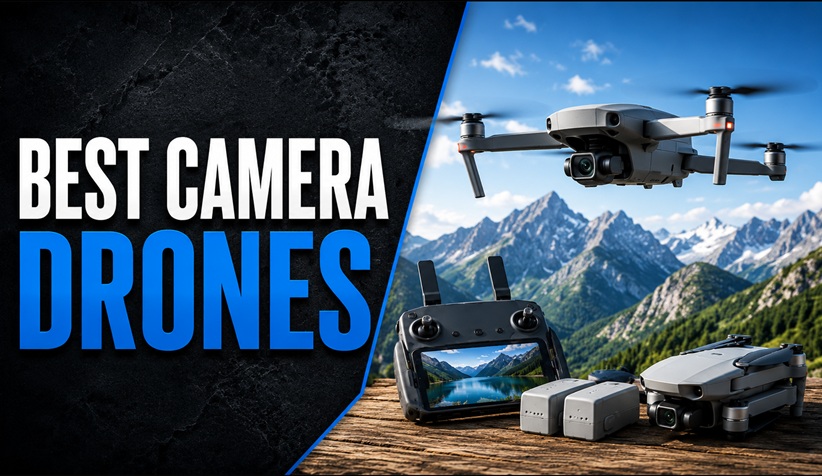
After years of professionally flying drones across my country, I’ve selected my top drones for photography in 2026, with one option for every budget. Here’s the quick overview, followed by a more detailed breakdown below. So, let’s start!
Quick Answer
For most people, the DJI Air 3S (~$1,099) is the best camera drone — it hits the sweet spot between image quality and price with a 1-inch main sensor, a second 70mm camera, and 45 minutes of flight time. If you shoot professionally and need the absolute best image quality, the DJI Mavic 4 Pro (~$2,199+) is the top camera drone on the market, with a triple-camera Hasselblad system and 6K/60fps HDR video. If you want the lightest drone with a real 1-inch sensor for travel, get the DJI Mini 5 Pro (~$799) — it stays under 250g so there’s no FAA registration required.
Features & Specs Comparison
Approximate US prices and specs, mid-2026. Prices shift with sales and bundle choice.
| Drone | Price (from) | Main Sensor | Cameras | Max Video | Flight Time | Weight | Best For |
|---|---|---|---|---|---|---|---|
| DJI Mavic 4 Pro Best Overall |
$2,199 | 4/3″ Hasselblad | Triple (28/70/168mm) | 6K/60fps HDR | ~51 min | 1,063g | Professional photo & video |
| DJI Air 3S Best Value |
$1,099 | 1″ | Dual (24/70mm) | 4K/120fps | ~45 min | 724g | Most serious photographers |
| DJI Mini 5 Pro | $799 | 1″ | Single | 4K/60fps | 36–52 min | <250g | Travel, no FAA registration |
| DJI Mini 4 Pro | $759 | 1/1.3″ | Single | 4K/60fps | ~34 min | <249g | Compact all-rounder |
| DJI Flip | $639 | 1/1.3″ | Single | 4K/30fps | ~31 min | <249g | Budget pick, prop-guarded |
Weight over ~250g requires FAA registration ($5, one-time) for recreational flying in the US.
Most people buying their first “serious” drone make the same mistake: they shop for megapixels the way they’d shop for a phone camera. Sensor size, not resolution, is what actually decides whether your aerial shots look professional or look like a toy took them — and that one fact separates the best camera drones on the market from the dozens of forgettable ones.
2026 has been a genuinely strong year for camera drones. DJI’s Mavic 4 Pro pushed image quality further than any consumer drone before it, the Air 3S settled into the price-to-quality sweet spot most photographers actually want, and the sub-250g Mini 5 Pro finally put a real 1-inch sensor into a drone light enough to skip FAA registration entirely. Whether you want the best drone for photography, the sharpest pro video drones money can buy, or simply the best drones with a 4K camera under $800, this guide breaks down exactly which one fits your budget and your shot list.

Why You Can Trust This Guide
Every drone below is a current, verified model with an active manufacturer listing and independently confirmed specs. Prices and figures were cross-checked against manufacturer listings and multiple hands-on reviews as of mid-2026.
Our ranking criteria, in order of weight:
- Image quality — sensor size and real-world dynamic range, not marketing megapixels
- Value — what you get per dollar at each price tier
- Flight time and transmission range — real-world, not just advertised numbers
- Portability and regulatory class — whether it fits the way you actually travel and fly
What Actually Matters in a Camera Drone
Spec sheets throw a lot of numbers at you. Here’s which ones are worth paying for.
- Sensor size, not megapixels. A 1-inch sensor collects dramatically more light than the tiny sensors in budget drones, which is why it matters more than resolution for real image quality — especially at dusk, dawn, or in shadows.
- RAW and log color profiles. If you plan to edit footage seriously, look for D-Log or D-Log M support and RAW photo capture. Flat color profiles give you far more room to grade footage than a drone that “bakes in” contrast and saturation automatically.
- Real flight time, not the number on the box. Advertised flight times assume windless conditions and no active shooting. Expect 75-85% of the stated number in normal use.
- Weight class. Drones under ~250g skip FAA registration for recreational flying in the US and are usually easier to travel with internationally. Heavier drones with bigger sensors trade that convenience for image quality and wind stability.
- Obstacle avoidance and transmission range. Matters more than people expect once you’re flying near trees, buildings, or at range — a dropped signal near an obstacle is how drones get lost.
Best Camera Drones: Quick Comparison
| Drone | Price | Sensor | Max Video | Flight Time | Best For |
|---|---|---|---|---|---|
| DJI Mavic 4 Pro | $2,199+ | 4/3″ Hasselblad, triple cam | 6K/60fps HDR | ~51 min | Professional photo & video |
| DJI Air 3S | $1,099 | 1″, dual cam | 4K/120fps | ~45 min | Most serious photographers |
| DJI Mini 5 Pro | $799 | 1″ | 4K/60fps | 36–52 min | Travel, no registration |
| DJI Mini 4 Pro | $759 | 1/1.3″ | 4K/60fps | ~34 min | Compact all-rounder |
| DJI Flip | $639 | 1/1.3″ | 4K/30fps | ~31 min | Budget pick, prop-guarded |
| DJI Inspire 3 | 5-figure (with lenses) | Interchangeable, up to 8K | 8K RAW | Varies | Professional production work |
The Best Camera Drones, Reviewed
1. Best Overall Camera Drone: DJI Mavic 4 Pro
Best For Pros
Review
The DJI Mavic 4 Pro is the most capable camera drone most photographers will ever need, and it’s not particularly close. The headline is a genuine 4/3″ Hasselblad main sensor — roughly four times the light-gathering area of the 1-inch sensors found in the Air 3S — paired with two additional telephoto cameras at 70mm and 168mm equivalent. All three shoot 4K slow motion, and the main camera goes up to 6K/60fps HDR with full D-Log M and RAW frame stacking for serious post-production work.
The new 360° Infinity Gimbal is the real headline feature, though — it replaces the traditional hanging gimbal design and lets the camera physically rotate for true vertical shooting, rather than cropping a horizontal frame. Combined with 51 minutes of flight time and O4+ transmission reaching up to 30km, this is a drone built for people who get paid to fly, not just people who enjoy it.
Pros
- Best-in-class image quality with a true 4/3″ Hasselblad sensor
- Triple-camera system covers wide, medium, and long telephoto
- 360° Infinity Gimbal enables native vertical shooting
- 51-minute flight time, longest of any consumer drone
- Full D-Log M and RAW support for professional grading
Cons
- $2,199 starting price, $2,849 for the practical Fly More Combo
- Over 250g, so FAA registration is mandatory
- Overkill if you’re not shooting for clients
2. Best Value Camera Drone: DJI Air 3S
Best For Most People
Review
If the Mavic 4 Pro is the drone you buy once you’re being paid to fly, the Air 3S is the drone almost everyone else should actually buy. It carries a genuine 1-inch main sensor plus a 70mm medium telephoto camera, shoots 4K at up to 120fps for smooth slow motion, and supports 10-bit D-Log M color — a flat, gradeable profile that used to be reserved for drones twice the price.
At roughly half the cost of the Mavic 4 Pro, you give up the third camera, some resolution, and a bit of obstacle-avoidance sophistication — but for the vast majority of travel, real estate, and content-creation shooting, the Air 3S captures footage that’s very hard to tell apart from its flagship sibling.
Pros
- 1-inch main sensor at less than half the Mavic 4 Pro’s price
- 4K/120fps for genuinely smooth slow motion
- 45 minutes of flight time, close to flagship-level endurance
- 10-bit D-Log M for real color grading flexibility
Cons
- Only two cameras versus the Mavic 4 Pro’s three
- 724g means mandatory FAA registration
- Obstacle sensing is good but not flagship-level
3. Best for Travel: DJI Mini 5 Pro
Sub-250g
Review
The Mini 5 Pro solves a problem that’s followed DJI’s Mini line for years: it finally puts a real 1-inch sensor — the same sensor class as the much bigger Air 3S — into a body that weighs under 250 grams. That single spec matters more than it sounds; it means no FAA registration for recreational flying in the US, and in most countries it slides under the stricter drone regulations that apply to heavier aircraft.
A 225° rotating gimbal enables native vertical shooting, and flight time ranges from 36 to 52 minutes depending on the battery you use. The tradeoff versus the Air 3S is a single camera instead of two, and slightly less wind stability given the lighter frame — but for travel, hiking, or anywhere packing light matters, it’s hard to beat.
Pros
- Real 1-inch sensor in a sub-250g body — a first for this weight class
- No FAA registration needed for recreational flying
- 225° gimbal rotation for native vertical video
- Up to 52 minutes of flight time with the extended battery
Cons
- Single camera only, no telephoto option
- Less wind-stable than heavier drones in gusty conditions
4. Best Compact All-Rounder: DJI Mini 4 Pro

Review
Before the Mini 5 Pro existed, the Mini 4 Pro was DJI’s standout compact camera drone, and it’s still an excellent choice — especially now that it’s cheaper. It packs omnidirectional obstacle sensing into a sub-249g body, which is genuinely rare at this weight, plus O4 transmission reaching up to 20km. Image quality from its 1/1.3″ sensor won’t match the 1-inch sensors above it, but it’s still a clear step up from budget drones.
Pros
- Omnidirectional obstacle sensing, rare at this weight
- Sub-249g — no FAA registration needed
- O4 transmission range up to 20km
- Strong price-to-feature ratio now that the Mini 5 Pro exists
Cons
- Smaller 1/1.3″ sensor versus the Mini 5 Pro’s true 1-inch
- Only 34 minutes of flight time
5. Best Budget Camera Drone: DJI Flip

Review
The DJI Flip is the cheapest way into a “real” camera drone rather than a toy-grade one. Its signature feature is built-in propeller guards — unusual for a DJI camera drone — which combined with palm takeoff and landing makes it noticeably more forgiving for less experienced pilots. Image quality from its 1/1.3″ sensor is solid for the price, even if it can’t touch the sensors in the Mini 5 Pro or Air 3S.
Pros
- Built-in propeller guards, unusual for a camera drone this capable
- Palm takeoff and landing for easier handling
- Sub-249g — no FAA registration needed
- Lowest price of any DJI camera drone with a gimbal
Cons
- 4K capped at 30fps, no slow-motion 4K
- Smallest sensor of the group, weakest low-light performance
- Shortest flight time on this list at ~31 minutes
6. Best Professional Cinema Drone: DJI Inspire 3
Beyond Consumer Tier
Review
Everything above this point is a consumer drone, even the $2,199 Mavic 4 Pro. The DJI Inspire 3 is not — it’s the drone film and TV productions actually rent and own, built around an interchangeable-lens Zenmuse X9-8K camera that shoots true 8K RAW, with a dedicated dual-operator setup so one pilot flies while a second person independently controls the camera and gimbal. Pricing sits in five-figure territory once you add lenses and accessories, which puts it firmly outside “pro video drones” in the hobbyist sense and squarely in working-production equipment.
We’re including it here because “best camera drone” searches often mix consumer and professional intent, and if you’re shopping for a production company, real estate agency with commercial contracts, or a serious independent filmmaker, this is genuinely the category above the Mavic line — not just a more expensive version of it.
Pros
- True 8K RAW capture with interchangeable lenses
- Independent dual-operator camera and flight control
- Cinema-grade dynamic range and color science
- Built for repeated professional production use
Cons
- Five-figure investment once lenses and accessories are included
- Massively overkill for personal or hobbyist shooting
- Requires a two-person crew to use as designed
Looking for a Non-Chinese-Made Alternative?
Given the FCC situation described below, some buyers specifically want a camera drone that isn’t made in China. Here’s the honest answer: at the consumer photography level, the options are thin. Autel — the most obvious DJI competitor on paper — is manufactured in China and faces the same Covered List restrictions on new models going forward, so it doesn’t actually solve the concern. Brands like Skydio (US-made) and Parrot (French) do exist as non-Chinese alternatives, but both are built primarily for enterprise use — mapping, inspection, public safety — rather than consumer photography, and they’re priced and positioned accordingly.
If sourcing outside China is a hard requirement for you, the realistic path in 2026 is an enterprise-oriented platform rather than a direct consumer-camera-drone substitute. For personal aerial photography and videography specifically, there currently isn’t a non-Chinese drone that competes with the Air 3S or Mavic 4 Pro on image quality per dollar — which is worth knowing before you spend time searching for one.
A Quick Note on DJI Availability in the US (2026)
Since this list leans heavily on DJI, it’s worth being upfront: as of December 23, 2025, the FCC added DJI to its Covered List after a required federal security review wasn’t completed by the deadline. This blocks new DJI models from getting fresh FCC equipment authorization — it does not ground, disable, or ban drones that were already approved and sold, including every model reviewed above.
In practical terms: existing DJI drones remain fully legal to own, fly, and buy from current retail stock. What’s uncertain is longer-term parts availability, warranty support, and whether DJI’s next generation of drones will be able to launch in the US at all. If you’re buying today, every drone in this guide is currently purchasable — but it’s worth checking current availability before you buy, since this situation is still developing.
4K vs. 6K, RAW vs. JPEG: What the Video Specs Actually Mean
Camera drone marketing loves throwing around resolution and frame rate numbers, so here’s what actually changes your footage:
- 4K is enough for almost everyone. Unless you’re delivering footage for a large-screen commercial project, 4K from a 1-inch sensor will look excellent on any platform you’re likely to publish to, including 4K TVs and social media.
- 6K and higher matter for cropping and stabilization headroom. The Mavic 4 Pro’s 6K capture isn’t really about the extra detail — it gives editors room to crop, reframe, and stabilize footage in post without dropping below 4K in the final export.
- D-Log and D-Log M are for editors, not casual shooters. These flat color profiles look washed out straight out of the drone, but they preserve far more shadow and highlight detail for color grading. If you’re not planning to grade footage, a standard color profile will look better without any editing.
- RAW photos matter more than video specs for stills. If photography is your priority over video, prioritize sensor size and RAW support over frame rate — the Mavic 4 Pro’s 100MP RAW stills are the real reason it’s the pick for professional photography, not its video specs.
How to Choose Based on What You Actually Shoot
Spec comparisons only get you so far. Here’s how the picks above map to specific real-world use cases we get asked about most.
| Use Case | Recommended Drone | Why |
|---|---|---|
| Real estate photography | DJI Air 3S | 1-inch sensor handles HDR-heavy interiors/exteriors well; dual camera covers wide establishing shots and closer detail without repositioning |
| Weddings & events | DJI Mavic 4 Pro | Longer flight time and quieter operation matter for uninterrupted ceremony coverage; RAW stills hold up for print-quality client deliverables |
| Travel & hiking | DJI Mini 5 Pro | Sub-250g means no registration hassle at each new destination, and packs into a daypack without adding real weight |
| YouTube & social content | DJI Mini 4 Pro or Flip | 4K is more than enough for social platforms; lower cost matters more than sensor size for most creators at this stage |
| Film & commercial production | DJI Inspire 3 | Interchangeable lenses and dual-operator control are non-negotiable for production-level client work |
| First camera drone, unsure of needs | DJI Flip or Mini 4 Pro | Lower financial risk while you learn what you actually shoot most before investing in a bigger sensor |
If you don’t see your exact use case here, a simple rule covers most gaps: shoot stills of static subjects (real estate, landscapes) → prioritize sensor size. Shoot moving subjects or need slow motion (sports, events) → prioritize frame rate and a second camera for reframing without cropping. Fly often in tight or wooded spaces → prioritize obstacle sensing over everything else, since a lost drone costs more than any spec upgrade.
Essential Accessories You’ll Actually Need
The drone itself is only part of the budget. A few accessories aren’t optional if you’re shooting seriously:
- ND filters. A camera drone’s shutter speed needs to roughly match its frame rate for natural-looking motion blur (the “180-degree rule”), and outdoors in daylight that’s only achievable with neutral density filters cutting the light reaching the sensor. A basic ND set (ND8/16/32/64) runs $30–80 and is close to mandatory for anyone shooting video outdoors.
- Spare batteries. Even the Mavic 4 Pro’s 51-minute battery becomes 20-25 minutes of usable shooting time once you subtract takeoff, repositioning, and safety margin. Budget for at least one spare battery per drone, more if you’re shooting a full day.
- Fast microSD storage. 6K and 4K/120fps footage produces large files quickly — a 128GB or 256GB V30-rated card is the practical minimum for anything beyond casual shooting, and the Mavic 4 Pro’s Creator Combo bundles 512GB of onboard storage for exactly this reason.
- A proper case. Gimbal cameras are the most fragile part of any drone. A hard case with cutout foam protects the gimbal during transport far better than the included soft bag on base packages.
Mistakes to Avoid When Buying a Camera Drone
- Don’t buy on megapixels alone — a 1-inch 20MP sensor will outperform a tiny 48MP sensor in almost every real-world condition.
- Don’t ignore weight class if you travel — a drone over 250g means registration paperwork and, in some countries, real restrictions on where you can fly.
- Don’t assume “4K” means the same thing across brands — frame rate, bitrate, and sensor size all affect how that 4K actually looks.
- Don’t skip checking current FCC/import status before buying an imported or gray-market drone — stick to authorized retailers.
- Don’t overbuy — if you’re not selling your footage, the Air 3S or Mini 5 Pro will outperform your actual needs, not just your budget.
- Don’t skip ND filters if you shoot video outdoors — without them, footage gets a jittery, over-sharp look that no amount of editing fully fixes.
Final Verdict
If you only take one thing from this guide: the DJI Air 3S is the best camera drone for most people in 2026 — it delivers professional-feeling footage without professional pricing. Working photographers and videographers who need the absolute best image quality should go straight for the DJI Mavic 4 Pro. And if packability is your top priority, the DJI Mini 5 Pro is the first drone light enough to travel with freely that still shoots like a serious camera. Whichever you choose, match the drone to how you’ll actually use it — not to the spec sheet that looks most impressive.
